

Help
A blind man taught me that receiving help is not the opposite of strength.

This is Part 6 of a six-part series, running from familiar misery to the events that taught me how to crack my own armor and let love in. Each piece stands alone. Together they’re the on-ramp to my book, The Armored Heart, out October 1.
Part 1 — King Kong Ain’t Got Nothin’ on Me · June 11
Part 2 — I’ll Sleep When I’m Dead · June 23
Part 3 — The Battery · July 7
Part 4 — The Curse · July 11
Part 5 — Contraband · July 27
Part 6 — Help · August 14
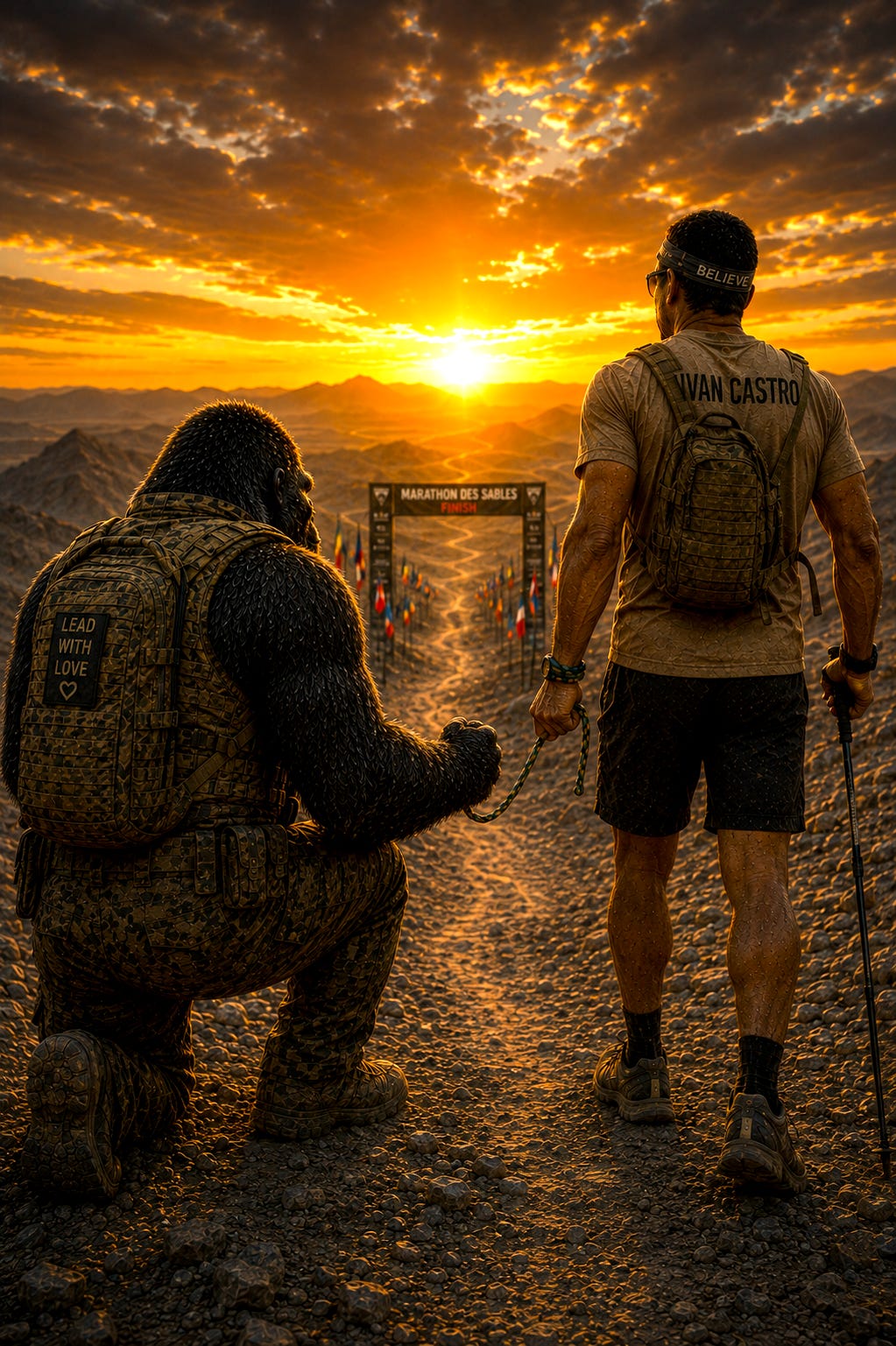
Last time (in Contraband) I left you standing at an open door, with the promise that the last piece would be about what happens when you finally allow the armor to open.
With my armor closed. It kept doing its job, quarantining the love, locking it in a box, letting it flood out only long enough to get it shut again. My immune system was working perfectly against the one thing it shouldn’t have been able to stop.
What now? This is the part where I tell you it didn’t get easier.
Knowing a door exists and walking through it are separated by a gap most strong people die on the wrong side of. I almost did, and I continue to slip back into this trap.
You can believe, all the way down, that you’re allowed to receive. You can write it on the wall. You can preach it to other men with real conviction.
When the moment comes, and someone tries to hand you something, the armor moves on its own and bats it away before your conscience gets a vote. Your ego is running the armor, and it is protecting you (with fear).
You have to get your ego out of the way.
I needed a teacher to learn this.
Mine couldn’t see.
The desert.
If you’ve been a reader for a while, or you know me, you know I used to run with a guy named Ivan. My brother Ivan.
For those who don’t, the short version is this. Ivan Castro is a Special Forces Soldier who lost his sight in Iraq, both eyes, in the same blast that nearly took the rest of him. He came back into a world gone permanently dark and decided he was going to run marathons anyway. Then ultramarathons. Then the kind of races that break men who can see every obstacle coming.
He runs tethered to a guide. For a lot of those miles, the guide was me.
People hear that, and they reach for the easy story. The noble sighted soldier giving his eyes to his wounded brother. Strength carrying weakness across the finish line. It makes a nice photo, and it is completely, dangerously wrong, and getting it wrong is the whole reason I’m writing. At all. And this piece today.
Because out there, tied together in more races than I can actually count, past the point where it was a gimmick and into a routine, to a place in the Sahara desert where my body wanted to quit and my pride wanted to pretend it didn’t, I figured out which one of us was actually doing the hard thing.
It wasn’t me.
The harder job.
Think about what it costs to do what Ivan does.
I get to be the helper. The helper’s role is the comfortable one, always, because the helper stays in control. I hold the tether, I call the terrain, I decide the pace. I get to be needed, and being needed is the drug my whole profession trained me to crave.
There is nothing on any running course that threatens my identity, unless I quit. With Ivan, I am the strong one giving. Same as I’ve always pretended to be.
Now stand where Ivan stands. Every single step, he places his life into another’s hands and trusts it will be caught. He cannot verify the ground. He cannot see the rock, the drop ahead, the hole that ends the race.
He runs full speed into a darkness he has no choice but to believe is being managed by someone else. He receives, continuously, for a hundred miles, the one thing I spent thirty years refusing to acknowledge after I received it on an airplane. Love. Help.
He takes the help.
And he does it without costing him an ounce of his strength, which upended everything I thought I knew. Because I had the equation the wrong way around my whole life.
I thought receiving was what you did when you ran out of strength. Ivan showed me receiving is a strength, a separate and harder one, the muscle the armored man never builds because he can’t.
I could give all day. I could suffer all day. Ask me to let someone catch me, and I’d lock up completely.
Ivan can’t see ... and he was free in the exact place I was imprisoned.
What the shoelace teaches.
We run connected by a shoestring. A loop of lace, one end in his hand, one in mine. That’s the whole technology. Thirty years of military budget behind me and the most important piece of equipment I ever carried costs a dollar and lives in a running shoe.
There’s a thing that happens on that string I have never been able to fully explain, and I’m not going to pretend to here. When it’s working, when the trust is total, and the miles are long, the line between helper and helped dissolves down the lace until I can’t find it.
I stop being the one giving, and he stops being the one taking. We become a single system moving across the earth, each of us carrying exactly what the other can’t. He can’t see the ground. I can’t run his race for him, can’t supply the staggering courage it takes to sprint into a dark that never ends. We are not strong-man-and-broken-man.
We are two halves of one runner, and neither half is the charity case.
That is what receiving actually does, once you finally let it. It does not make you the weak one in the picture. It completes a circuit. It cannot be closed any other way. The man who refuses to receive isn’t staying strong. He is just holding the circuit open.
Every alarm I owned told me that taking help would diminish me. The running that ended in a desert told me the opposite, and it took the running, and the mountains, and the desert to do it, because I would not have believed any other teachers. Endurance, suffering, and compassion together created the right cocktail.
All those years I thought I was guarding my strength by never needing anyone. I was wrong.
The thing I fight.
I have to be honest, because the whole point falls apart the second I start pretending I’ve arrived at the end of a journey.
I still fight it. The instinct to bat the help away has not left me. When I’m hurting, my first move is to carry it alone, to refuse the lace rather than trust it.
My armor isn’t gone. I’ve just learned, slowly, with a lot of help from a man who can’t see, a woman who loves me, and little humans that call me Dad, to override it for longer stretches before it slams shut.
The shape of receiving.
Not a door you walk through once and live on the far side of forever. A door you have to choose to open again every morning, against an alarm that never fully stops ringing in your head. Some days I get it open. Some days I catch myself an hour into pain, white-knuckling something I should have handed to my wife, or a brother, or God, before it ever got that heavy.
But I know the door is there now. I know which way it opens. And I know the strongest man I have ever run beside is the one who lets himself be carried, full speed, into the dark, on nothing but a shoestring and the trust that someone had the other end.
He never could see the finish line. He just believed it was being held for him.
Where this leaves us.
I started this series with a man in a familiar misery, refusing to choose. I’m ending it with a blind man sprinting into darkness on a dollar’s worth of shoelace, freer than I have ever been.
Everything between those two men is the road I walked. The currency of pain. The rest I could not take. The battery not charged. The curse I learned to aim instead of cure. The love that landed on a C-130 ramp and took me twenty years to stop treating as contraband. Six hard looks at the same wound, and one shoestring teaching me the way out.
This is where the on-ramp ends, because this is where the book must begin.
The Armored Heart comes out October 1. It is the long version of everything you read in this series, the whole story of how the armor went on, what it cost the people I love (and still costs them), and how a blinded friend and a length of shoelace finally started prying it off. I could not have written it until I learned to receive it, and I could not talk about how you can receive it until I told you the truth about how badly I have failed at it.
So I’ll leave you where I meet Ivan at the start of every race. At the starting line, in the dark, holding one end of the string.
Now that the end is in your hand. All you have to do is hold on to it.
I can’t tie that up neat. I don’t know how.
The Armored Heart is available October 1 from Shakeridge Press. These essays were the on-ramp. The book is the road.
Lead with Love.
— Doom
I am sorry I have missed some episodes, and I will go back and read them. Asking for help is hard when you are the one being strong. It is MUCH harder to lead then to follow. I like what you have done with this "on-ramp" to the book.
Ivan is a mf'ing dawg!!