

The Battery
Trauma? You want to talk about trauma?

There’s an old NFL press conference that lives forever on the internet.
Jim Mora, head coach of the Colts, gets asked about the playoffs after an ugly loss, and something in him snaps. Playoffs? He says it like the word itself is the insult. Playoffs?! Don’t talk about playoffs. You kidding me? Playoffs?
I think about that clip every time someone says the word trauma to a veteran.
Not because the trauma isn’t real. Mine is real. My brothers’ and sisters’ is real, and nothing in this piece walks one inch of that back.
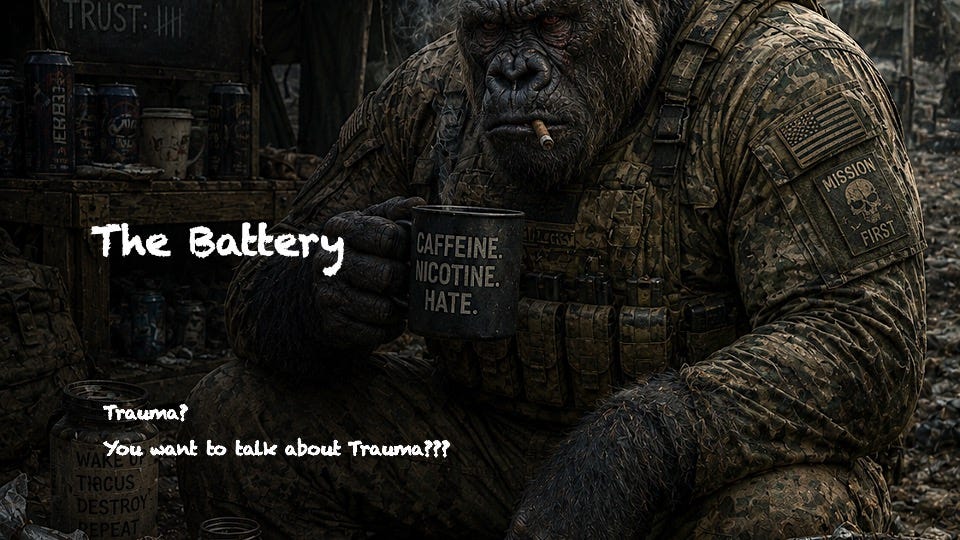
I think about Mora because of the incredulity. Because the question itself misses what actually happened, and some part of every veteran I know wants to do the full rant. Trauma? You want to talk about trauma? You kidding me? Trauma…
The word arrives pre-loaded. The VA hands it over, stamped and coded as PTSD, which lands like an insult.
The family whispers it in the kitchen. The culture assigns it the second they hear the word veteran. And the word isn’t completely wrong. It’s doing the work of ten or more words, and at least nine of them are getting ignored.
So let’s talk about the others.
Lead with Love — The Ledger Series
What the strong do with pain. And the long road to setting it down.
This is part three of a six-part series running from familiar misery to the events and the shoestring that taught me how to crack my own armor and let love in. Each piece stands alone. Together, they are the on-ramp to my book, The Armored Heart, out October 1.
Part 1 — King Kong Ain’t Got Nothin’ on Me · June 11
Part 2 — I’ll Sleep When I’m Dead · June 23
Part 3 — The Battery · July 7
Part 4 — The Curse · July 21
Part 5 — Contraband · August 4
Part 6 — Help · August 18
The inventory.
Picture the mind we’re discussing. A mind that can run fifty variables at once, on no sleep, on whatever calories the situation allows, and hold them all without dropping one, because dropping one gets somebody killed.
Now look at what’s fueling it beyond the empty calories.
Enough caffeine to kill three normal humans. Nicotine at levels that would make the Marlboro Man feel like a pencil-neck geek. Copenhagen packed so deep and so constantly that teeth turn a permanent shade of tan. Energy drinks stacked on coffee stacked on whatever -tine one can get their hands on… and when the -tines run out, whatever the next guy was using to keep going.
The food engineered to survive a nuclear winter, or whatever the locals were eating, eaten standing up, at hours the body doesn’t recognize as mealtimes. It wasn’t doing us any favors.
And underneath the chemistry, the reason for it. Nobody was chasing a buzz. Staying awake was the mission inside the mission.
Staying awake means you are doing your job, and maybe that's enough to keep your buddy from getting killed. The hypervigilance that the textbooks call a symptom is sometimes the job description. The combat mind is discipline stacked atop fear, and we ran that configuration for years.
We ran it on a battery that was never once allowed to fully charge. Discipline, to us, meant doing anything and everything we could, running ourselves ragged without complaint.
This is what the word trauma skips. We didn’t just see terrible things. We saw them while making nothing but withdrawals. A decade of withdrawals and too few deposits. Sleep debt with compound interest. A nervous system redlined as a matter of daily duty, not as a malfunction.
The sinister part.
Everything we used to stay awake and alert was doing a second job, and the second job was sabotage.
The caffeine, the nicotine, the dip, and then whatever could be used to come down at night, from handfuls of melatonin to Ambien, and often worse…as folks started using smuggled-in alcohol or ketamine to come down. Combine the chemicals and lack of sleep with the food that wasn’t really food in some cases, and it was quietly burning down a factory most of us didn’t know we owned. The gut.
The place where most of the body’s serotonin gets made (yes, the mood chemistry starts in your intestines, not your skull), where the raw materials the brain needs for its own supply get processed before your brain ever touches them. Very few of us understood the importance of the gut biome, and we knew less about what we were doing to it.
We firebombed it. Daily. For years. As standard operating procedure.
So follow the chain. The gut gets wrecked, the production line slows, and serotonin and dopamine drive off a cliff together. The brain that already ran hot now runs hot and empty. The wiring that already looked like ADHD now looks worse because the chemicals that regulate attention and reward are bottoming out. The nervous system is maxed, and the tank is dry at the same time.
And what does that look like from the outside?
Bloodshot eyes. White knuckles. A man full of caffeine and hate, full of righteous vengeance for the enemy that brings that back and snaps at his family, gripping the wheel of his life, unable to say why.
Write trauma on that man’s chart, and you’ve named maybe a third of him. The rest is a depleted brain in a poisoned body on a dead battery. It is presenting, conveniently, as exactly the thing you already wrote down. PTSD isn’t the only thing.
Why the word matters.
This is the part that makes the misdiagnosis dangerous instead of just ill-fitting.
When everything gets read as trauma, treatment aims at the memory and skips the battery. And a depleted nervous system can’t do the trauma work. You cannot process your way out of physiological bankruptcy. The processing itself costs energy you don’t have.
So the veterans sit in the therapy chair, drained, wired, half poisoned, and fail at treatment. Week after week. And they draw the only conclusion the evidence seems to support. That they’re broken beyond repair. The thing wrong with them is so deep that even the professionals can’t reach it. THIS IS A LIE, and it is killing people.
They aren’t broken beyond repair. They’re uncharged. Wrong diagnosis, wrong sequence, one more reason to stop showing up.
I’ll say my part plainly, because dancing around it dishonors them: some of the brothers and sisters we lost didn’t lose to their memories. They lost to a battle plan that marched them into the memories with an empty tank, then called it their failure when they fell.
Both things are true.
Hear me clearly.
The trauma is real. The wounds are real. Nothing about the battery erases what happened or what it cost.
But trauma is the wound. Depletion is the background. Try to close a wound on a body like that, and it never closes, no matter how skilled the hands working on it. Charge the battery first. The sleep. The actual food. The slow retreat from the parade of -tines. Rebuild the factory floor, and then the trauma work has a body to live in. The memories don’t get smaller, but the man facing them gets bigger, and that turns out to be the same thing.
I’ve written about the ledger that traps strong men, and about the rest we keep refusing.
But there’s one more thing, and it’s the one underneath all the others. Because a fair question is still sitting there unanswered. If the battery is this dead and the body is this poisoned, why does the man keep reaching for the very things that drain him? Why go hunting for the next risk, the next fight, the next emergency, when every cell is begging him to stop?
The answer is the next piece in this series, and it isn’t a diagnosis. It’s a curse.
The right question.
Mora was right to be incredulous. They were asking him the wrong question, and the wrongness of it was the whole story.
So is everyone who asks a veteran only about his trauma.
The right question is older, simpler, and almost nobody asks it.
When was the last time you were full?
Full of sleep. Full of real food. Full of quiet that didn’t feel like a threat.
Ask a Veteran that. Then sit with how long it takes them to answer.
Lead with Love.
— Doom
Loving this series Doom. Tough to work on a mind when the body and processes that support brain health are wrecked.