

The SWAMP
Leaders, Followers, and Tests you don't see coming

Guide to Human | Follow the path to your humanity.
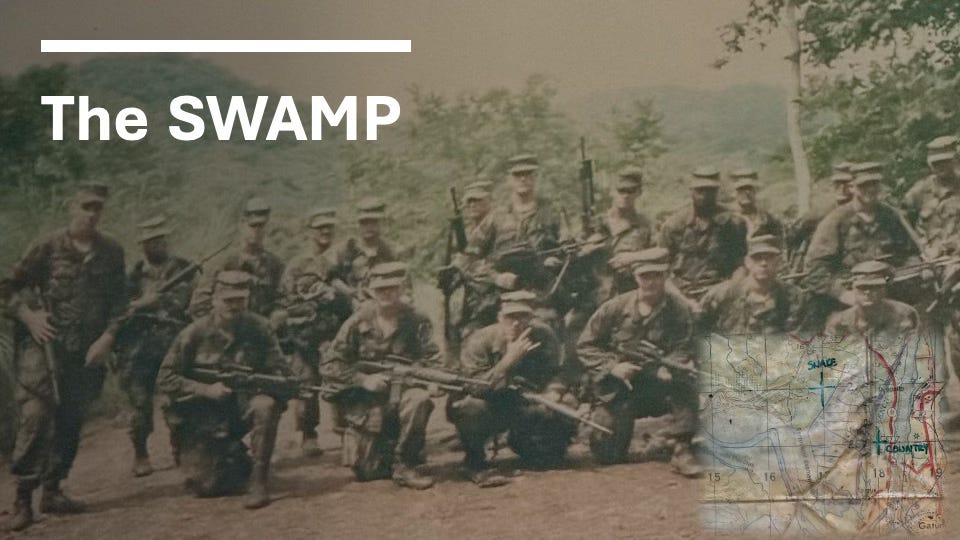
The Army didn’t make me a leader when they pinned a gold bar on my collar.
Not when I graduated from the Infantry Officers Course, not when I stepped off the aircraft at Tocumen airport in Panama, nor when I was assigned as an Infantry Platoon Leader at Fort Kobbe.
Those were transactions. The Army conferred rank. What it cannot confer is credibility.
Credibility has exactly one source: the people you lead decide to give it to you.
Or they don’t.
I know the precise moment when I reached that tipping point.
Tests
My platoon was operating as OPFOR (the opposing force) in the Panamanian jungle near Fort Sherman. We were the bad guys for a stateside unit going through the Army’s Jungle school.
Our job was to make life miserable for a unit rotating in from the States during jungle school. Most of my platoon knew every trail, every ambush site, every patrol route that felt clever but wasn’t. I was a new guy. They told me a lot of times they just made contact with the unit, started a fight, eventually died, and then went home. I wanted to win.
We were moving through dense jungle, heading west away from Gatun Drop Zone, where we had just parachuted into 6-foot-high grass. We were dehydrated, the heat was beyond oppressive, and you could almost feel your pores getting ready to quit.
Then we hit the edge of the Mohjinga swamp. The Mohjinga is not a metaphor. It is an actual piece of hell—chest-deep black water, roots you can’t see, rot smell, things that bite you that you never get a look at. The lead squad had halted as we reached the swamp. I moved to the front to see the obstacle that had stopped us.
I looked into the swamp. It looked bad. It was a place no one should attempt to walk through.
As I pondered the predicament, A Staff Sergeant stepped up and kneeled beside me. He was the senior squad leader, not the platoon sergeant—that position was occupied by a man who had a habit of being somewhere else when the field would be uncomfortable. He quietly disappeared from the unit a few months later, with my help pointing out the pattern to the chain of command.
But that day in the Mohjinga, his absence meant this SSG, although not the next most senior NCO, was standing in a spot that wasn’t technically his. He knew it. I knew it. Neither of us said so.
He was experienced, respected, the kind of NCO who had forgotten more about the jungle than I had yet learned. And he was doing something that doesn’t show up in any doctrine: he was filling a vacuum because someone who mattered was gone, and the mission—and maybe the lieutenant—needed someone standing there.
“LT. We're really going into the Mohjinga?”
Yes, I told him.
“Sir, we’ve tried this before. We got miserably lost. Many, many, many hours later, we walked back out the same side we went in, looking like we’d scrapped with the Hell’s Angels.”
He wasn’t being insubordinate. He was doing two jobs at once—his own and the one nobody had officially asked him to do. Good follower-leaders feel the vacuum when someone above them is absent. The ones worth keeping step into it anyway, not to take the position, but because the organization needs someone standing there. That instinct is its own kind of competence, and you learn to recognize it.
Early in your time with an organization, you may not always know which kind of counsel you’re receiving.
There are NCOs who give you their honest read because they want the mission to succeed, and they’ve seen what happens when lieutenants don’t know the answer, or are afraid to ask. And there are NCOs who give you the easy way out answer because it’s easier on everybody, including themselves.
Both sound like experience. The only way to know the difference is to already know the problem well enough to test the answer against reality. Which means the decision burden never actually leaves you. The counsel is an input. The call is still yours. As the saying goes, you can delegate authority but never responsibility.
What he didn’t know was that I had seen this type of conversation play out in front of me on several occasions. I had been a medic in an Infantry platoon. Yes, it was the National Guard, but my Platoon Sergeant was a Vietnam Vet, and he kept me close to him. “Doc, wherever I go, you go. If I need you, it will be an emergency. I don’t want to come looking for you.”
This proximity had allowed me to watch my Platoon Sergeant talk to various Lieutenants. I heard the decisions, the reasoning, the aftermath. I’d been studying how this worked long before I was the man leading a Platoon.
I sat with what he said, and then I walked him through it.
Down that trail behind us is the Rio Mohjinga bridge. The unit from the States will have an ambush on that bridge—that’s doctrine, and they will follow it. Going back the way we came takes us back three kilometers to the Drop Zone (a wide-open area where we jumped in). The enemy heard the aircraft. Gatun will have patrols all over it.
So, if we want to get to Fort Sherman without that unit seeing us—which is the entire point of our existence out here—we are going to do the thing none of them thinks we will do, and none of us really wants to do. We are going to walk through this swamp.
Silence.
“OK, LT. I’ll back this play for now. But I warned you.”
Six Hours
Six miserable hours. The swamp did everything it promised to do. Dark water. Thick roots. No trail, no landmarks, just compass bearings and pace counts, and every man in the platoon knowing exactly who had decided to walk them into this. Me.
Here’s what Fred remembers. I was afraid. Not of the swamp. Afraid of being wrong. Afraid of the weight of what it means when thirty men are following your decision into a place they can’t see the bottom of, literally and otherwise. That fear didn’t go away. I just had to be more useful than it was.
I also kept thinking about the alternative. If I had said OK, let’s go back. My soldiers wouldn’t know whether I could navigate them out of the worst shit, and trust me, there would be days it would be worse. That was still an open question. What they would have known, with certainty, is that I could be talked out of a hard decision. That I’d move off a call when someone pushed.
You can recover from a navigation error. You cannot recover from the reputation of being the guy who folds under pressure. That follows you everywhere you go after.
We emerged on dry-ish land on the northern side of the swamp. Closer to Fort Sherman. Well north of where the defending unit would ever think to look for us. We stopped, and the platoon went into the procedures of establishing a patrol base—security out, everybody quiet, nobody moving—and we started listening for movement. Except for an occasional Howler Monkey, it was quiet.
The same Staff Sergeant appeared at my elbow in the center of the patrol base.
“OK, Platoon Leader. Are we staying here? If not, how long until we move?”
I smiled. He smiled back.
He didn’t say “good job.” That’s not what that moment was. But I noticed what he said. Not “LT.” Not “Sir.”
“Platoon Leader.”
In the military, you learn to read the register of what you’re called. “LT” with a certain edge is a test—not contempt, not quite, but close enough to feel the gap between what you are on paper and what you may or may not have earned in practice.
“Platoon Leader” is something else. Yes, it’s a title, but when an NCO who has been watching you, hands it back across hours and hours of black water and bad footing, it means he’s decided you’ve earned it. He wasn’t going to say anything more than that. He didn’t need to. Neither did I.
He’d made a bet I was a man who wasn’t afraid to discuss options, and that once I listened to him, he bet his credibility with mine. I’d made him look right on both counts. That’s the kind of relationship that builds a unit, and it starts with someone willing to fill the vacuum when the person who’s supposed to be there isn’t.
Lessons
Doom would tell you this is a story about tactical decision-making under uncertainty. About terrain analysis. About how a leader earns credibility through competence. That’s all true, and it’s also incomplete.
In the Mohjinga swamp, I listened to the man and then made the call.
Listening isn’t compliance. You take the input, you test it against what you know, and then you decide. What you cannot do is let the pressure of the moment substitute for the work of thinking it through. If I had said OK because he pushed, and not because he was right, that would have been its own kind of failure. A quieter one, easier to rationalize.
I still chew on what moments like that teach and what they cost.
The moments I’ve failed as a leader, and there have been more than I’d like to count, were almost always moments where I was more concerned with appearing certain in uncertainty, or more concerned with avoiding friction than holding a position I had actually thought through. I would pay the price as a more senior officer for being the guy who speaks truth to power, but that can become a weight you just want to put down. I regretted every time I did.
The swamp worked because I couldn’t fake it. The decision was too exposed, the terrain too unforgiving. It forced me to actually lead with no backstop.
The Credibility Account
Your people are always watching what you do. Always. This is not cynical; it’s the most rational thing about the people you lead. They execute your decisions with their bodies, their time, their lives. Of course they’re watching.
What they are watching for, more than anything else, is whether you know what you’re doing, will you listen to someone else in the event you do not know what you are doing, and can you be moved off a decision by someone who doesn’t want to do the hard right thing. These are all separate tests running simultaneously. Pass one and fail another, and you haven’t passed.
The credibility account doesn’t accumulate from performance reviews or how well you brief a plan. It accumulates from the moments people are watching you think under pressure, how you handle the bad options, whether your reasoning is honest when it’s uncomfortable, whether the call you make is the one you actually believe in, or the one that gets everybody off your back fastest.
Like when you make your kids eat broccoli, do you love your people enough to lead through the hard right over the easy wrong?
And here’s what the Mohjinga also taught me about the people watching: the ones worth keeping are filling gaps you don’t even know exist yet. They step into vacuums. They give you honest counsel when the easier move is silence. When you find one doing the right thing, hold the line well enough to make them look right for stepping up to question you, and then support them.
First followers are important.
That’s not a transaction. That’s how organizations become great.
You still have to be the one willing to be wrong if the plan goes to shit.
The smile when we came out the other side of a swamp wasn’t approval. It was recognition.
Something closer to: there you are. We’ve been waiting to see who you'd be.
That’s the moment. Not a ceremony. Not a promotion. Not a title on a door.
That is it.
Lead with Love.
—Doom
Damn. It’s been awhile since I thought about the Mohjinga or reflected on my PL time. This piece brought it all back, including the jungle smells. BZ. DOL.