

Traps
Bait, taking it, and what it means…

Some insults are about your reaction to them. Some are so subtle, so calculated, so planned, they hit you in a soft spot, while others might seem oblivious.
A man insulted me to my face a few days ago. He did it with a humble smile and a little giggle, a smugness. It was subtle. Maybe too subtle for the others at the table to notice. I won’t tell you all of what he said or who he is. It doesn’t matter. What matters is what he wanted.
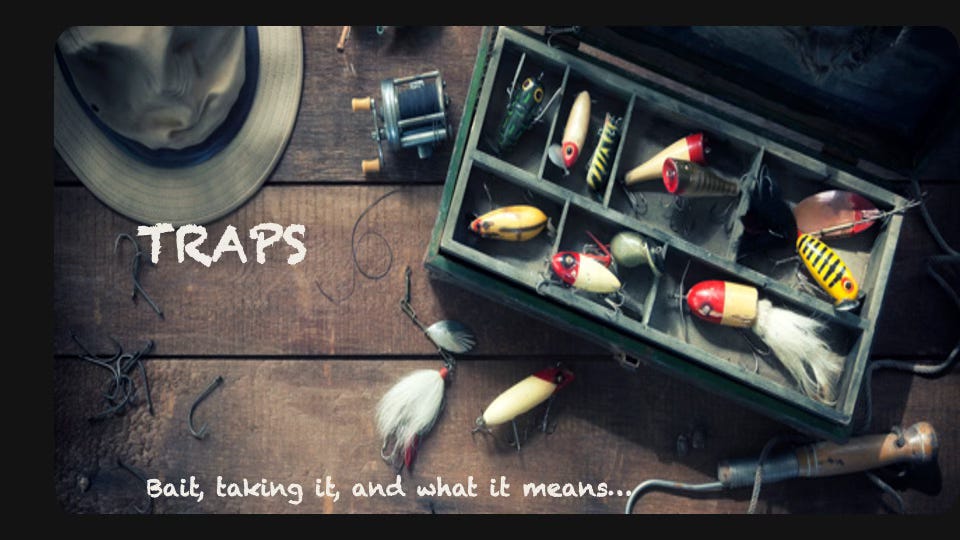
He wanted me to swing. Not really swing, but bring the rage.
The insult wasn’t an argument. It wasn’t even really about me. It was about his worldview. It was a hook, baited and cast, and the only thing it was designed to catch was my reaction. If I’d taken the bait, raised my voice, leaned toward him, become for ten seconds the angry man, the imperialist tool he’d called me, well…he’d have won. Not the exchange. The story. The story he was telling (maybe has been telling) about me to the person we both cared about, the person sitting right there watching. I’m not sure she noticed his jab. That was by design.
I didn’t react. Watching the bait sit there in the water with nothing biting it was the most satisfying thing I’ve done in a while.
I’ve been a man others have tried to provoke for many years, in places of death, with real villains, real evil, an evil many will never see up close. The consequences for others of my overreaction? Death. I understand the weight of reacting to bait.
Many comments aren’t designed to open a reasoned debate or even start an argument. A debate is an exchange of ideas, an argument an attempt to sway opinion.
A baited trap of this nature wants to influence others’ behavior with your reaction. And the people who set traps are not interested in what’s true. They’re interested in what you’ll do, and how that makes others think about you.
Outrage bait on social media is a clean version of this behavior. You see it every day now, engineered into the feed, but it works the same in a kitchen, in an email, across a conference table. Someone says the thing. The thing that’s a little too sharp, a little too unfair, calibrated to land right on the nerve. And your whole body lights up. The heat comes. The response writes itself before you’ve decided to write it.
That heat is not yours. They put it there. They reached into you and turned it on, and the speed of it …the way it bypasses every part of the thinking you… The speed is the proof it was installed, not chosen.
They already have a story about you. They need you to confirm it. The provocation exists to manufacture the evidence. Call a steady man aggressive enough times in the right way, and eventually he gets loud, and now you point and say, see, I told you, look at him. You authored the moment. The action was performed. And to everyone watching, it just looks like confirmation.
That’s the whole game. Make the person become the caricature so the caricature looks earned.
It works in rules too. The same move, but slower. A rule written not to govern but to provoke. The petty enforcement, the technicality deployed at exactly the moment it’ll sting most. The policy applied to some, but somehow never applied to all. It’s designed to invoke protests. And the protests become the file. People get labeled difficult; they can’t follow a process, take direction, or be rational. The rules are not about order. They are a tripwire, and a reasonable objection becomes an emotional explosion. The explosion they want on the record.
In emails, it’s the sentence engineered to be screenshotted. In a family, it’s the comment dropped at the dinner table for everyone to hear, waiting for you to overreact so the overreaction becomes the topic instead of the comment. In every case, the structure is identical. Provoke. Record the reaction. Sell the reaction as proof of the bias.
How do you not swing?
First, you have to feel it and name it. The heat comes. You let it come. You don’t pretend you’re above it, because a man who doesn’t feel the insult gets no credit for staying still. You feel all of it. And then, in the half-second before the response launches, you ask one question. Who benefits if I react right now?
If the answer is them, you have your answer.
Second, you remember the audience. You’re almost never performing for the person who baited you. They’re a lost cause. They came to provoke. You’re performing for whoever’s watching. A kid, the team, the thread, the people who’ll decide later who turned out to be who they said they were. The bait artist needs you to look like the monster for the audience. The most devastating thing you can do to them is decline. Be so plainly not the thing they called you that the label falls off in the air between you.
Smugness has no power over a man it can’t provoke. The giggle, the little verbal jab, the satisfied wait for you to take it. All of it. It depends on your reaction. Your stillness leaves them holding a hook with nothing on it, in front of everyone, and now they’re the one who looks strange. They came to fish. They caught nothing. And the silence does to them exactly what they meant the insult to do to you.
Third, and this is the hard one. You play the long game. The bait artist is always playing short. They win by getting the reaction now, today. You win by being the same steady person across years, the one whose dignity held when it had every reason not to. Short games feel like winning right up until they don’t. The person who just keeps showing up, unprovoked and unbothered, and is still there outlasts the performer almost every time. Performers get tired. Steadiness doesn’t.
None of this is weakness. I want to be clear about that, because the rage will come back later and tell you that not reacting was cowardice. It wasn’t. Restraint in the face of a thing built to break your restraint is the harder discipline by a mile. Anyone can swing, can take the bait.
The control to feel its full weight and not move is the rarer strength, and it’s the one that wins.
The insult was never meant to be true. It was intended to make you react. To influence. So don’t make it true. Be still.
That’s not you losing the exchange.
That’s you refusing to be the villain in someone else’s story.
Lead With Love,
Doom
This is SO well written, Fred. I don't understand why some people try to draw power from deliberate provocation - why does it feed them? The rise in incivility boggles my mind when I see or experience it out in the wild - while I can see increased temptation when someone is safely behind a screen, it is happening more often in face-to-face interactions as you described. (Side note - how stupid is that person to deliberately try to piss you, of all people, off?!?)
Perhaps this is a result of people feeling more powerless in their daily lives and this is how they consciously or subconsciously deal with it. Not that that makes it ok, but sometimes trying to figure out why someone is doing something hurtful helps me deal with it more calmly and rationally. I appreciate your insight in this article though. You provide a good model to emulate!
Totally get ya', why I'm happy being a hermit. Here's the thing; lots of folks lack the capacity to recognize hazard when it's looking right at them. C'mon Col., we don't just get off our bike one day and decide we're never going to ride again. We might be from different worlds, but while the ass-wagon is busy talkin' smack, I'm picking targets. Just in case.